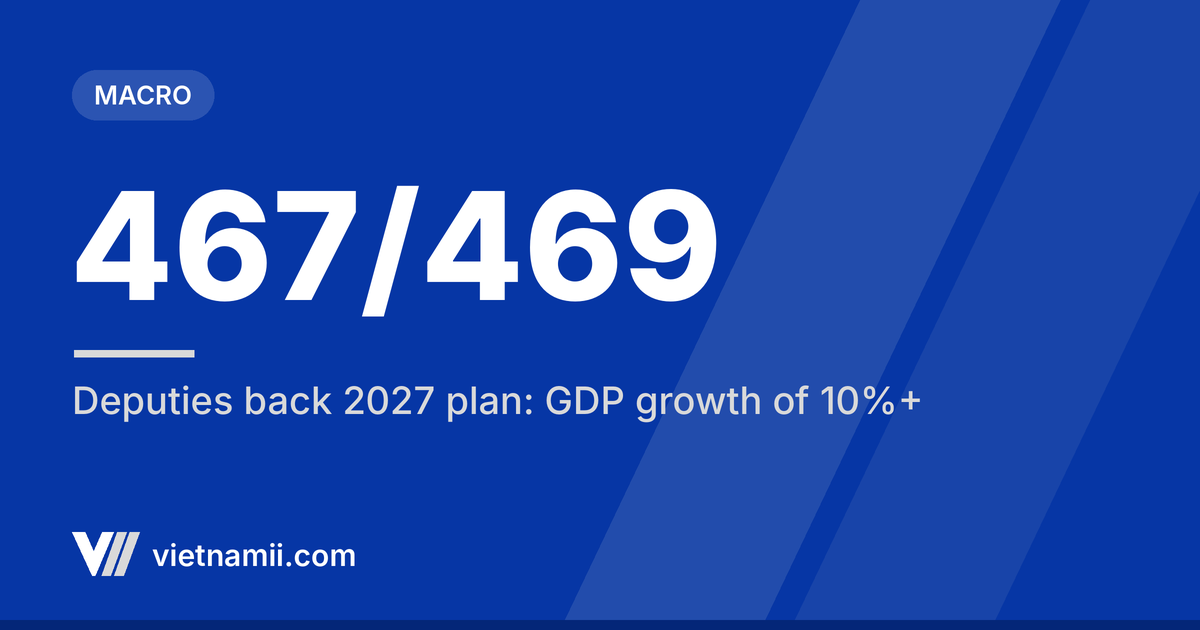
On the morning of 7 November 2026, at the second session of the 16th National Assembly, lawmakers adopted the Resolution on the 2027 socio-economic development plan. According to the session's press release No. 20, 469 deputies took part in the vote and 467 voted in favour, equal to 93.40% of all deputies. Before the vote, the Minister of Finance, on behalf of the Prime Minister, presented the report explaining and incorporating comments on the draft.
The vote turns the targets proposed by the Government into formal tasks for 2027, giving a clear framework for policy management and for business planning.
Key targets confirmed
- Economic growth: 10% or more.
- GDP per capita: about US$6,100.
- Inflation: kept at about 4.5%.
The double-digit growth goal comes with a requirement to keep the macro economy stable, signalling that growth is the priority but not at the cost of major economic balances.
Credit, capital markets and real estate
The resolution tasks the Government with managing interest rates and the exchange rate in line with domestic and global conditions, lowering lending rates, steering credit to production and priority sectors, and controlling credit risk. Of note for investors, it calls for a modern medium- and long-term capital market, quick implementation of wider foreign ownership limits in sectors that do not affect national security, encouragement for FDI firms to reinvest profits in Vietnam, and operation of the international financial centre.
For banks, the direction is to modernise the system, resolve bad debt and prevent cross-ownership. The property market is to develop in a healthy and sustainable way, with long-stalled projects to be cleared.
Infrastructure and energy as pillars
The resolution requires sufficient supply of electricity and petroleum in all situations, a national energy reserve strategy and faster power projects. In transport, the focus is on completing the expressway network, including the eastern and western North–South routes and East–West axes; advancing the Lao Cai–Hanoi–Hai Phong railway, the North–South high-speed railway and urban rail; and speeding up Long Thanh and Gia Binh international airports. It also calls for an end to localities investing in airports, seaports, data centres and free trade zones simply to follow a trend.
Other directions include developing the private sector under Resolution 68-NQ/TW, helping household businesses become enterprises, tackling the trade deficit, and pushing digital transformation and science and technology.
Under the session agenda, the Assembly is scheduled to vote on 9 November 2026 on the 2027 state budget estimate and the 2027 central budget allocation plan.
Key takeaways
- The 2027 plan resolution passed with 467 of 469 votes (93.40% of all deputies).
- Targets: GDP growth of 10% or more, per-capita GDP of about US$6,100, inflation of about 4.5%.
- A medium- and long-term capital market, wider foreign ownership limits, lower lending rates and infrastructure and energy are the key directions for businesses and investors.