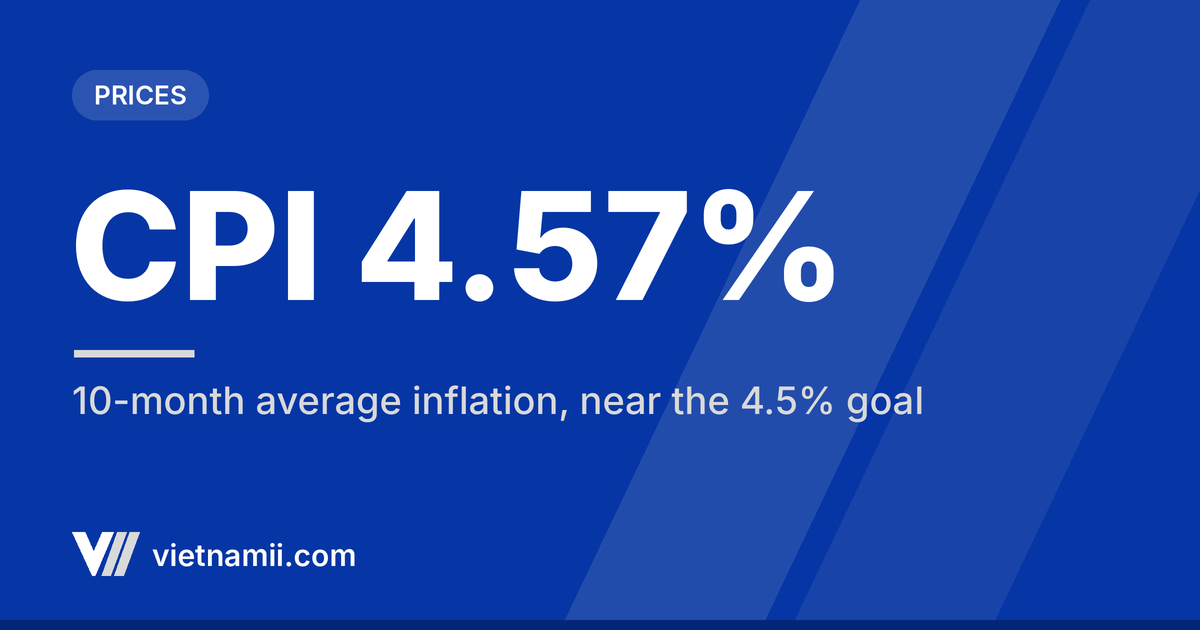
According to the National Statistics Office (Ministry of Finance), the consumer price index (CPI) rose 0.2% month on month in October 2026, slowing sharply from 0.62% in September and marking the smallest increase in three months. Over the first ten months, CPI averaged 4.57% higher year on year, with core inflation at 4.24%, close to the National Assembly's target of about 4.5% for 2026.
What is happening to prices?
- Transport rose the most in October (+2.66%) as domestic petrol prices followed global oil.
- Food and foodstuffs fell 0.24%, with pork down 2.33% thanks to ample domestic supply and cheaper imports.
- Core inflation eased slightly month on month, showing that price pressure is concentrated in energy rather than spreading across the economy.
Timely price relief
From 1 November 2026, average retail power prices fell 2% and the special consumption tax on petrol was cut to zero, which is expected to lower petrol prices by about VND1,500–1,700 per litre. Because transport and housing-utilities are two of the largest contributors to CPI growth this year, these measures target exactly the hot spots of inflation. Deputy Prime Minister Nguyen Van Thang also called for closer market monitoring and action against unjustified price rises, especially where input costs have fallen.
Full-year scenarios
The Ministry of Finance has two scenarios for 2026 inflation, at 4.5% and 4.8%; the State Bank expects 4.5–5%. With October CPI rising slowly and the energy relief package in effect, there is a good chance of keeping inflation near target, even though year-end and Lunar New Year demand usually brings seasonal price pressure.
Impact on Vietnam's economy
- Real income: stable inflation preserves purchasing power, with average worker income already up about 9.4%.
- Interest rates: controlled inflation helps keep lending rates stable, supporting firms that borrow to expand.
- Growth: Vietnam is achieving a rare combination of high growth (9.01% in nine months) and moderate inflation.
- Financial markets: stable inflation is key for domestic and foreign investors to trust the value of the currency and long-term assets.
Expert perspective
Experts note that pressure remains from year-end spending, faster public investment, credit growth and exchange-rate moves. They recommend keeping prices of state-managed goods stable and combining medium- and long-term measures for lasting cost relief.
vietnamii.com view: keeping CPI around 4.5% while growing this fast is a notable achievement of macro management. The power price and petrol tax cuts will be an important cushion for the last two months of the year.